
At most team-building events, people settle into the room and direct their attention toward the front long before the facilitator even gets on stage. The screen they find there can seem like a minor production detail, yet it helps determine whether the group feels connected to one shared activity or divided into separate pockets.
Because of that, this piece of equipment deserves more thought, especially when the event depends on quick reactions and visible participation. The real question is how an LED wall can transform a corporate team-building event without overdoing it. That’s what we’re here to find out.
A Shared Screen Changes the Room’s Social Focus
A projector works well when attendees mostly need to read slides. Team building asks more of the visual setup because the room may need to follow a live challenge as it unfolds. An LED wall can display a camera feed alongside the game’s current score, making the display part of the activity rather than just a decorative backdrop.
That common focal point changes how people respond. A clever answer from one table reaches the entire room, and a late comeback becomes something everyone can watch in real time. The activity gains the energy of a shared experience even when a large ballroom naturally separates people into smaller groups.
Visible Progress Gives Competition More Energy
A facilitator can announce scores between rounds, but spoken updates tend to go in one ear and out the other. A persistent leaderboard lets teams see where they stand while the next challenge gets underway. It also makes progress easier to understand when points carry across several rounds.
The wall can build anticipation without pushing the event into game-show territory. A countdown adds pressure to a timed puzzle, while a restrained animation can recognize the team that moves into first place. Those cues create momentum because they respond directly to what participants are doing.
Fast Instructions Become Easier to Follow

Activities lose energy when half the room is still decoding the directions. With enough display area, an LED wall can keep the current prompt visible while a facilitator demonstrates the task on camera. People near the back don’t have to rely on a small stage view or repeat the instructions across their table.
This setup becomes especially useful when an exercise has several stages. The operator can change the visual as soon as the facilitator advances, which tells every group that it should move at the same time. Clear transitions reduce the awkward pause when some teams start early while others are waiting for confirmation.
It’s also worth noting that LED panels hold up better than projection in rooms with substantial ambient light. You won’t necessarily need to darken the venue just to make instructions readable, so participants can still see their materials and one another. The room remains practical for collaboration while the display stays prominent.
Hybrid Teammates Can Feel Present
Remote participation often becomes an afterthought when virtual attendees appear as a strip of small boxes on a distant screen. A wide LED wall provides the production team with enough canvas to display remote teammates at a useful scale while keeping the active prompt visible. That makes it easier for people in the room to read reactions and direct comments toward their off-site colleagues.
The wall can’t create inclusion on its own, though. The activity still needs turns that give remote participants a clear way to contribute, and the camera angle should let them see more than the backs of chairs. When the event format supports them, a strong visual presence helps remote teammates feel like players rather than spectators.
Content Must Fit the Wall
An ordinary slide deck rarely becomes more engaging just because someone stretches it across a larger surface. LED walls often use custom dimensions, so teams can build content for the actual canvas instead of being forced into a standard presentation ratio. Otherwise, the event ends up with unused space or awkwardly enlarged graphics.
Good wall content favors clear hierarchy and deliberate movement. A team name should remain readable from the farthest occupied seat, while an animated cue should draw attention to the next action. Still, constant motion can distract from the activity, as participants tend to watch the background more than listen to their own teammates.
Interactive Formats Give Teams More Ownership
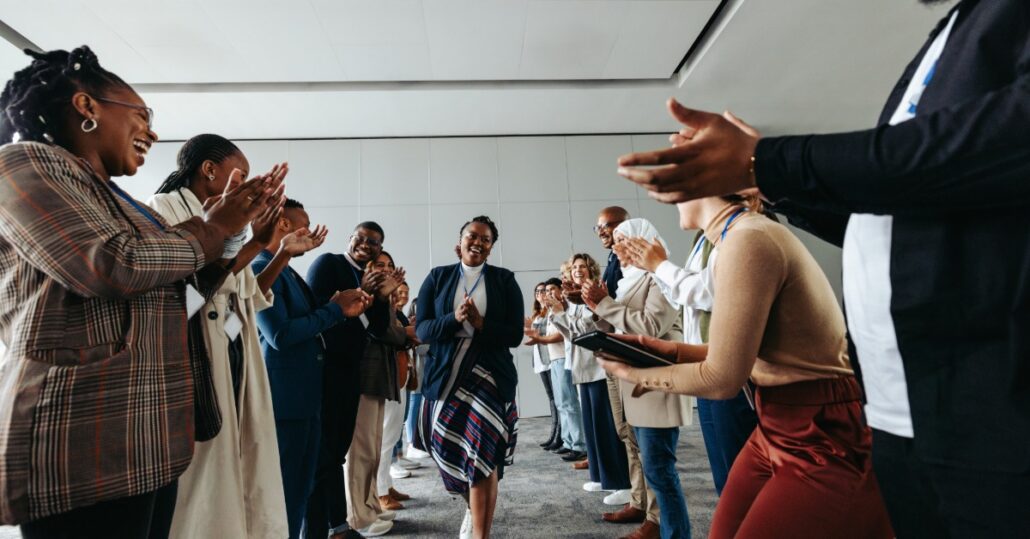
An LED wall becomes more valuable for corporate team-building when participants can influence what appears on it. Teams might submit an answer from a mobile device and see the overall response change immediately. The display then reflects the room’s decisions instead of delivering content in only one direction.
Creative exercises can use the same principle. A group might produce a short video during the session, then watch it play at a scale that makes the work feel event-worthy. That public moment raises the stakes in a friendly way because the output receives more attention than it would on a laptop screen.
Production Choices Shape Participation
The largest available wall isn’t automatically the right one. Its dimensions should suit the viewing distance and the amount of information the activity needs to display. If participants sit close to the screen, a finer pixel pitch can keep text and faces from looking coarse.
Placement deserves equal care because a visually impressive wall won’t help people who can’t see it. The display should clear stage activity without forcing participants at the front to look sharply upward. Brightness should also match the room rather than overpower it, particularly when teams need to work face to face.
Finding a provider of corporate event production audio-visual rentals will be helpful when trying to coordinate the wall with the sound system and room layout. That coordination matters when a live camera feed needs to match the action onstage or when a visual cue lands at the same moment as an audio sting. Production feels polished when those elements behave like one system.
Rehearsal Keeps the Technology Out of the Way
An LED wall may look spontaneous during the event, but the best visual moments usually depend on precise cues. The run of show should identify what appears when a round begins and what changes after the facilitator announces a result. An operator can then follow the room instead of guessing which asset comes next.
A rehearsal should use the actual content whenever possible. This gives the facilitator time to check sightlines from the stage and lets the operator confirm that live inputs appear in the correct portion of the wall. It also exposes transitions that take too long and graphics that look clear on a laptop but fail at room scale.
Teams shouldn’t have to wait through a technical reset while their enthusiasm drains away. A simple holding visual can preserve focus if a live feed drops, and the facilitator should know how to continue without it. The LED wall works best when it strengthens the event’s rhythm without becoming the event itself.